
Protecting the Minds of the Young: Social Media Is Rewriting Childhood in Real Time
Feb 20, 2026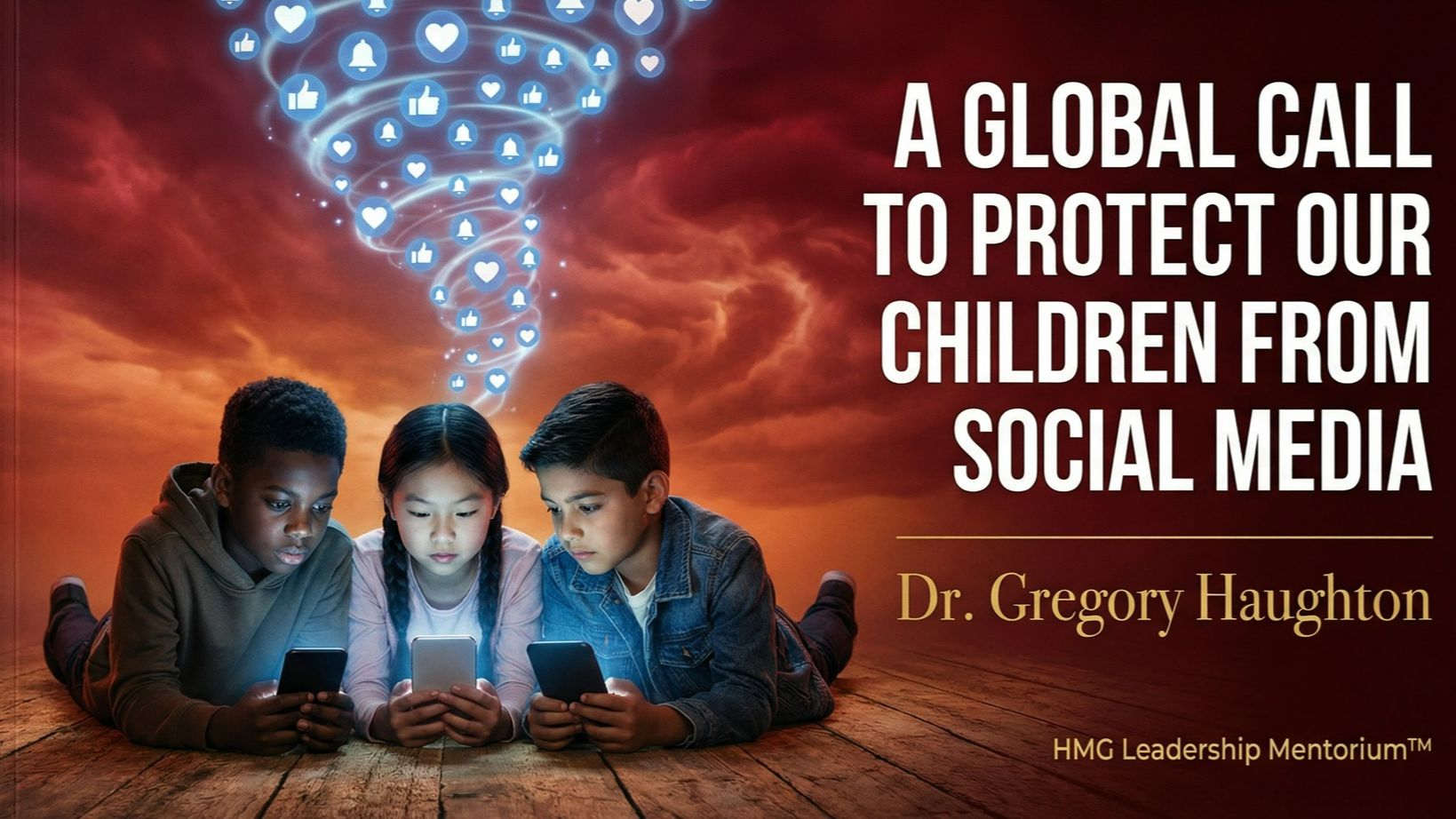
By Dr. Gregory Haughton
Let me speak to parents.
We are watching a quiet crisis unfold in real time. Not in the streets, on screens. Not in one home, across an entire generation. Social media has become the most powerful classroom many children will ever sit in, yet no one elected it, no one meaningfully regulates it, and most children do not have the developmental capacity to understand what it is doing to them.
Here is the reality every parent, educator, and policymaker must acknowledge:
The true danger of social media isn’t what children post; it’s what it programs.
Public health leaders have been sounding the alarm. The U.S. Surgeon General has warned that we cannot conclude social media is sufficiently safe for children and adolescents. The American Psychological Association has issued formal guidance urging risk reduction, particularly around sleep disruption, content exposure, and problematic usage patterns.
Here is the most valuable lesson many adults overlook: children are not small adults. Their impulse control, emotional regulation, and identity formation are still under construction. When a system designed to maximize attention, validation-seeking, and comparison collides with a developing brain, the result is not neutral. It is formative.
Do you know the actual damage Social Media Is Doing to our Children?
This conversation is not about declaring social media “all bad.” Many young people find community and connection online, but the risk patterns are too consistent to ignore.
Heavier or problematic use is associated with higher rates of depression, anxiety, stress symptoms, and sleep disruption. More revealing still, when exposure decreases, mental health indicators often improve. A study published in JAMA Network Open found that just one week away from social media reduced symptoms of anxiety, depression, and insomnia in participants.
That does not mean every child needs a digital detox. It does mean that volume and intensity matter.
Beyond mental health, the cultural consequences are profound. Social media trains children to perform for approval. It conditions them to equate attention with worth and engagement with identity. When the algorithm becomes the mirror, insecurity becomes profitable, and childhood becomes a marketplace.
Parents must step up and protect their children. We should not outsource our duty to Congress Too many people are waiting for government to fix this, but policy moves slowly, and constitutional constraints around speech make sweeping regulation complex, particularly in the United States. State-level attempts to restrict access for minors or require parental consent have repeatedly faced legal challenges.
Yes, lawmakers have limits. Courts have limits. Enforcement has limits, but most technology does not, which means meaningful protection cannot begin in Washington alone.
It must begin in homes, schools, and communities, and then scale upward into policy.
Why should this be a priority for every parent.
In the HMG Leadership Mentorium™, I teach that every system produces what it is designed to produce. If you do not install structure, the environment will install it for you.
Social media is doing exactly that, installing beliefs, habits, and identity scripts without permission.
Leadership requires a proactive stance grounded in three clear principles.
First, boundaries are not punishment; they are protection. Children do not need unlimited access to unlimited influence. Time limits, device-free spaces, and nighttime restrictions are not outdated ideas. They are brain-health strategies.
Second, digital literacy must become foundational. Children must be explicitly taught how algorithms function, how outrage spreads, why comparison distorts reality, and how platforms are engineered to hold attention. If discernment is not taught, dependence will be.
Third, problematic social media use must be treated as a legitimate behavioral risk. When a child cannot disengage, cannot sleep, cannot focus, or cannot regulate mood without a device, that is not a harmless phase. It is a developmental warning sign.
Outside the United States, some nations may have greater flexibility to regulate platforms and enforce age protections. But regardless of geography, the hierarchy remains the same: parents shape the daily environment, schools shape norms, and governments set accountability standards.
When those three align, children have protection. When they hesitate, the algorithm wins by default.
Finally, a generation is being shaped, not just by teachers and coaches, but by trends, influencers, and systems designed to capture attention. If you don’t lead the system, the system will lead you.
This isn’t about arguing whether social media is good or bad. It’s about stepping up as guardians of our children’s development. Our children may not fully understand the long-term consequences of misuse. But we do. And real leadership is protecting what cannot yet protect itself.
Follow new blog posts and updates!
Join our mailing list to receive the latest blog posts and updates from Dr. Greg.
Don't worry, your information will not be shared.
We hate SPAM. We will never sell your information, for any reason.