Why Leaders Must Develop an Olympic Mindset
Dec 17, 2025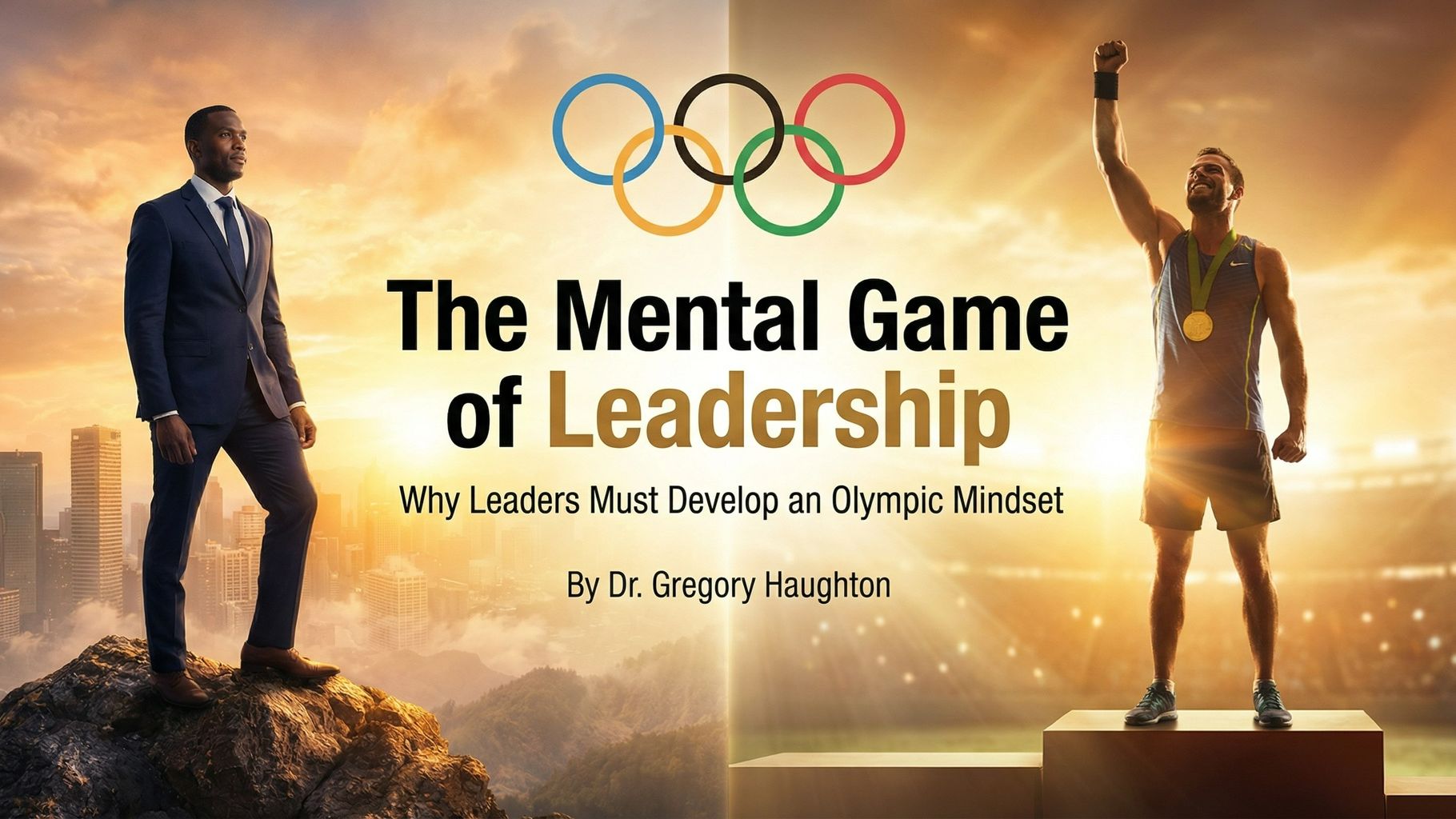
By Dr. Gregory Haughton
In today’s high-stakes leadership environment, the pressure is not just constant; it is a fundamental part of the job. Recent data reveals that 76% of executives report emotional distress tied directly to work demands, while 56% experienced burnout in 2024 alone. These statistics highlight a profound and consequential truth: too many leaders are attempting to win a psychological game with purely tactical tools. While investment in strategy, data, and operations is crucial, it often overshadows the most potent performance lever of all: the leader’s own mind. At the highest level, leadership is less about what you know and more about how effectively you think, regulate your emotions, and maintain resilience under pressure.
As an Olympic medalist who has competed on the world’s biggest stage and a scholar of performance with a PhD in Business, I have witnessed this reality play out time and again. The differentiator between good leaders and great ones is rarely intelligence or opportunity; it is mental fortitude. The same principles that enable an athlete to perform when everything is on the line are the very principles that allow a leader to remain clear, decisive, and composed when the stakes are highest. This is what I define as the Olympic Mindset, a state of mental mastery that is not innate but developed through systematic training.
Where Mental Toughness Meets Business Strategy
At first glance, the worlds of elite sport and executive leadership may seem worlds apart. Psychologically, however, they are strikingly similar. An INSEAD study of 111 CEOs revealed that their most significant challenges were not technical or strategic, but mental, balancing intuition with data, managing personal bias, and navigating the isolation that comes with ultimate accountability. These are the exact pressures Olympians are trained to confront.
In elite sports, physical preparation is only half the equation; athletes systematically train their minds to perform amid what sports psychologists call “disruptive pressure,” moments when plans unravel, conditions shift unexpectedly, and success depends entirely on mental control. The outdated pursuit of a flawless “flow state” has given way to a more realistic and powerful demand: the ability to perform through uncertainty and chaos.
Executives operate in this same environment of relentless scrutiny, making high-stakes decisions with incomplete information and the expectation of consistent delivery despite market volatility. The critical difference is not the pressure itself, but the preparation for it. While athletes have long embraced mental training as an essential discipline, many leaders still treat it as optional. This creates a significant “self-awareness gap,” in which leaders overestimate their ability to manage the psychological demands of their roles, leaving their most valuable asset, their minds, untrained and vulnerable.
The Three Pillars of Mental Excellence
Developing an Olympic Mindset is not a matter of chance; it requires the intentional cultivation of the mental frameworks that sustain elite performance. Through decades of competition and my work with leaders across industries, three pillars consistently emerge as the foundation of mental mastery.
- Transform Pressure into Performance Fuel
Anxiety is an unavoidable component of any high-stakes environment. The Olympic Mindset does not seek to eliminate it but to harness it. Research published in the Journal of Experimental Psychology shows that performers who reframe anxiety as excitement significantly outperform those who attempt to suppress it. Physiologically, the energy is identical; the difference lies in its interpretation. For leaders, this means redefining moments of pressure. A critical board presentation is no longer a threat to be feared but an electric opportunity to be seized. A high-risk decision becomes energizing rather than paralyzing. This crucial mental shift prevents the brain’s threat response from hijacking performance, allowing leaders to channel intensity into heightened focus and clarity.
- Embrace a Data-Driven Growth Mindset
In many corporate cultures, failure is quietly feared and carefully concealed. In elite sports, by contrast, a poor performance is treated as invaluable data. It is analyzed without ego and without blame, with a singular objective: to refine the process. The key question is not “Did I fail?” but “What does this outcome reveal?” If the execution was sound and the outcome was outside of your control, that is not failure; it is competition. If, however, the execution was flawed, the data becomes a blueprint for improvement. This disciplined, evidence-based reflection builds true resilience and aligns with research identifying a growth mindset as a defining trait of high-performing leaders. It transforms setbacks from indictments of worth into opportunities for growth.
- Master Strategic Mental Recovery
One of the most dangerous myths in leadership is that relentless, non-stop effort produces superior results. Olympic champions understand a different truth: recovery is not the absence of training; it is a vital part of training. Sports scientists often refer to intentional rest as “the forgotten session” because of its central role in sustaining peak performance. For executives, recovery extends beyond sleep, though sleep is non-negotiable. Strategic mental recovery requires intentional disengagement through activities that replenish cognitive and emotional capacity. Research from Texas Christian University found that leaders who incorporated meaningful social connection into their recovery routines consistently outperformed those who did not. Whether through time in nature, shared meals with loved ones, creative pursuits, or quiet reflection, these moments rebuild the mental stamina required for sustained excellence.
A Systematic Path to Mental Mastery
No Olympian steps onto the world stage without a coach and a structured training system. Similarly, leaders should not be expected to navigate the relentless complexity of their roles without one. This conviction is the foundation of my Six-Stage Leadership Mentorium, a disciplined, data-driven framework designed to systematically develop the mental clarity, emotional control, and performance consistency required to lead under pressure.
The consequences of neglecting this mental preparation are well-documented. A staggering 60% of new managers fail within their first two years, primarily because they are unequipped to handle the psychological demands of leadership. At the executive level, 65% of CEOs report difficulty balancing competing stakeholder interests, while 60% struggle to lead through unpredictable market conditions. In this environment, mental resilience is no longer a soft skill; it is a competitive necessity.
The future of leadership belongs to those who recognize that sustainable success requires more than just strategy and execution. It demands mental discipline under pressure, emotional intelligence in complex human systems, and the resilience to learn from every setback without losing momentum. Leadership is not won solely in the boardroom or on the balance sheet. It is won in the mind.
Experience reveals that it is only a matter of time; the pressure will come. Therefore, are you training your mind with the same intentionality that you apply to every other aspect of your leadership?
Follow new blog posts and updates!
Join our mailing list to receive the latest blog posts and updates from Dr. Greg.
Don't worry, your information will not be shared.
We hate SPAM. We will never sell your information, for any reason.